MegaloMail Times Vol 1
AI Models
Kimi K3 Becomes the Largest Open Model Ever
Moonshot's new 2.8 trillion parameter model took the top spot on a coding leaderboard within hours of launch. That's the part that got my attention, not the size.
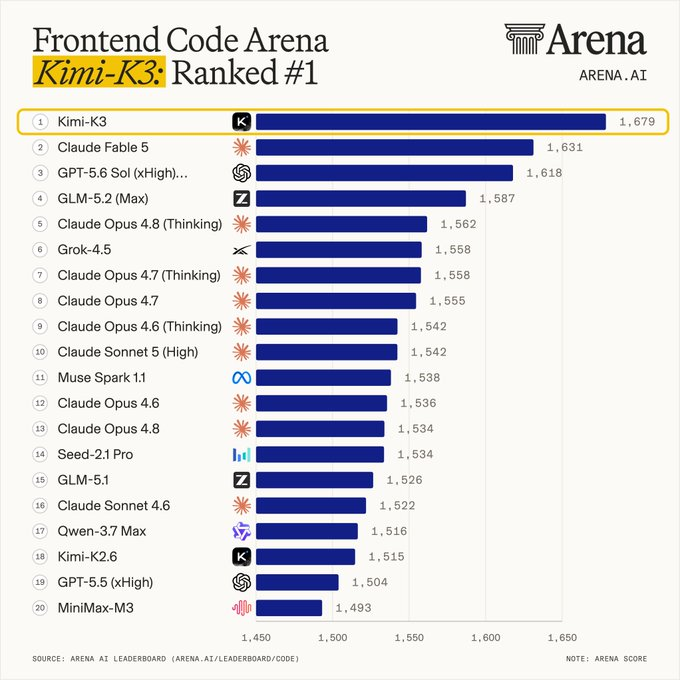
Arena AI's Frontend Code Arena leaderboard, hours after K3's launch.
Moonshot AI released Kimi K3 on July 16, 2026. It has about 2.8 trillion parameters, making it the biggest open weight model released so far, more than double the size of its own K2.7 Code model with a 1 million token context window and a new attention design called Kimi Delta Attention. Within hours of launch, K3 jumped to the top of the Frontend Code Arena leaderboard, and overtaking Claude Fable 5.
Mathematics
Claude Fable Helps Disprove an 87 Year Old Math Problem
Claude Fable 5 helped disprove a math problem that had been open since 1939.
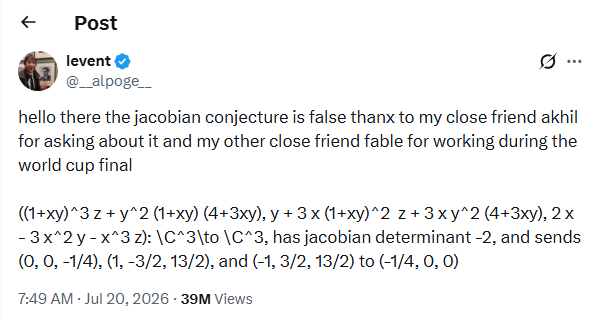
Levent Alpöge's announcement on X, July 20, 2026.
Anthropic researcher Levent Alpöge used Claude Fable 5 to find a counterexample to the Jacobian conjecture, a problem mathematicians had been stuck on since 1939. The conjecture asked whether certain polynomial functions could always be reversed once they passed a specific test. Fable produced a three dimensional polynomial map that breaks the rule, but the two dimensional case is still open.
Apps
Clavicular Launches an AI Face Scanning App
Looksmaxxing influencer Clavicular, launched Face Harmony, an app that uses AI to scan a user's face and give feedback on things like symmetry and proportions. It also offers grooming and style suggestions, with a paid tier unlocking a full report. The app launched right after Clavicular's widely covered trip to Tel Aviv.
Face Harmony by Clavicular, on the App Store.
Acquisitions
Cognition Buys the Team Behind Poke
The Devin makers aquired Poke, the texting agent that has already handled over 100 million messages, to build coding and personal agents on the same foundation.
Cognition's announcement welcoming The Interaction Company.
Mathematics
GPT-5.6 Pro Disproves a 30 Year Old Graph Theory Conjecture
Researcher Dmitry Rybin just needed four prompts to get GPT 5.6 Pro to break a graph theory conjecture that had stood open since the late 1990s.
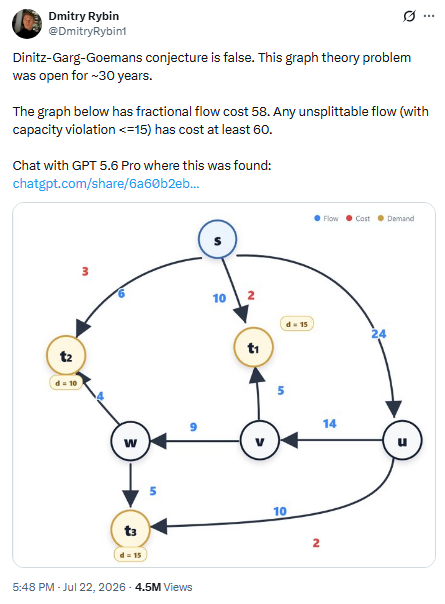
Dmitry Rybin's counterexample graph, posted July 22, 2026.
Researcher Dmitry Rybin says he got GPT-5.6 Pro to disprove the Dinitz-Garg-Goemans conjecture, a graph theory problem open since the late 1990s. The conjecture claimed that a flow split across multiple routes could always be converted into a single route flow without raising cost or congestion by much. Rybin used just four prompts, including one that simply told the model to keep going after it reported no progress for hours. The model eventually produced a seven node graph along with a full verification proof. The result still needs independent review, but it lands right after Fable's Jacobian conjecture result, adding to a fast growing list of long standing math problems falling to AI.
MegaloMail Times by megalo.me